John K. Kalua · At work in Northern California · 2026
Meet John K. Kalua
At nearly 90, John is still building what others say cannot be done.
For more than fifty years, John has designed, fabricated, repaired, and solved difficult problems for wineries, hospitals, manufacturers, public works, churches, and communities across Northern California. Today he is carrying that hard-earned knowledge into NuTrend’s next generation of environmental systems—and inviting others into the shop to learn beside him. He does not begin by forcing a product onto a problem. He studies what the system was designed to do, finds what is preventing function, and builds the most responsible path forward.
Wineries · Hospitals · Manufacturingsystems designed, built, repaired, and trusted
Measurements. Calculations. Questions. A solution taking shape.
The man behind NuTrend
His college was work. His diploma was trust.
Born on Molokaʻi, Hawaiʻi, John K. Kalua built his education in working shops, active plants, construction sites, wineries, hospitals, and the difficult moments when something had to work in the real world.
He became a fabricator, inventor, supervisor, trainer, troubleshooter, and the person people called when the usual answers were not enough. His work includes winery production systems, sparkling-wine automation, specialized industrial equipment, public structures, hospitals, environmental systems, and one-of-a-kind solutions.
John’s work begins with respect for what is already there: the people who live with the problem, the material properties others may have overlooked, and the function the system is still trying to perform. He does not command a broken system to work. He restores the pathway that makes safe, useful operation possible again.
Today, John is still at his Lakeport worktable—developing biomass and winery-filtration systems, contributing to wildfire-resilience concepts, guiding NuTrend’s future projects, and passing his practical problem-solving method to a new generation.
“I’m pumped to have another task to solve. Let’s get going on obtaining a new project.”
— John K. Kalua, after nearing completion of one of the most difficult projects he has solved
The article that documented the work
Recognized then. Still building now.
In September 1976, a national construction magazine introduced John K. Kalua to its readers as an inventor, engineer, metal fabricator, contractor, and problem solver. The history that follows explains how that recognition was earned—and why John is still working today.
Merit Shop Contractor · September 1976 · Pages 14–15
John K. Kalua: A Merit Shop Milestone
The national magazine profiled John at 39 as the Associated Builders and Contractors’ 10,000th member and presented K&K Metal Construction as a fast-growing St. Helena company serving Napa Valley’s wine country.
Identified John as an inventor, engineer, metal fabricator, and contractor.
Reported that K&K was approaching $1 million in annual construction volume and growing approximately 30% per year.
Documented the patented “Safe Lock” hook, mercury-recovery equipment, dredging systems, and winery-system designs.
Recorded “It’s No Problem” as John’s familiar response when others needed an answer.
Credited John with designing and constructing the Pacific Union College bell tower in Angwin.
UC Berkeley · The Bancroft Library · Oral History Center · 1992
Domaine Chandon: The First French-Owned California Sparkling Wine Cellar
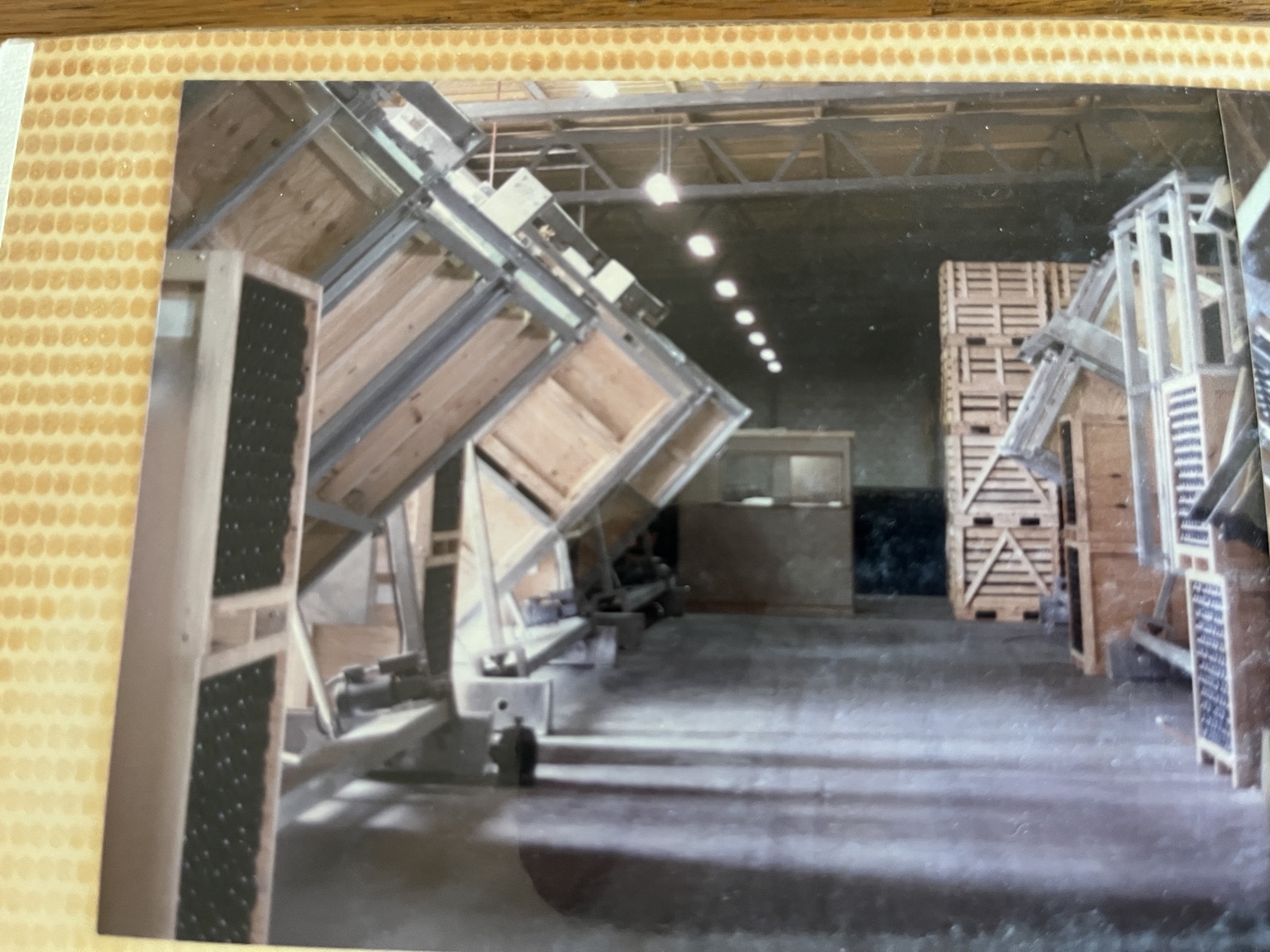
In John H. Wright’s oral history, Wright recalls that Domaine Chandon production leader Gino Zepponi took a large-scale riddling concept to John K. Kalua. Wright describes John as especially capable of reducing ideas to practice and credits him with the practical design of the Very Large Machine.
The system increased capacity from roughly 400 bottles to approximately 4,000 while still using two motors. Wright said the large machine worked better than the smaller machines in some respects—an institutional account of John’s role in scaling sparkling-wine automation.
The transcript misspells John’s surname as “Kahlua.” John’s reference appears on PDF page 105 in the supplied archival copy.
This is a growing record. Additional publications, photographs, and archival sources will be added as they are located and verified.
An invitation to learn from John
Step into the shop and learn how a lifetime problem-solver approaches the work.
John has been teaching people to weld for most of his working life. Crew members who worked beside him were apprenticed not only in how to strike an arc, but in how to understand the material, recognize the real problem, and build something that would hold.
Over the years, he has also welcomed hobbyists and curious beginners who simply wanted to learn. Most recently, he has been teaching his niece—his brother Robert’s daughter—how to weld so she can renovate a bus into a practical home for her work as a traveling nurse.
Now John is opening his Lakeport shop to a small group of new students. No previous welding or machining experience is required—just curiosity, a willingness to learn, and the desire to make something useful with your own hands.
Lakeport
Beginner Metal Construction, Fabrication & Welding
John is most valuable when the answer is not obvious, the cost of failure is real, and someone must understand the whole system before changing one part.
01
Equipment & fabrication
A machine, component, or physical system that is failing, unavailable, unsafe, or no longer supported.
02
Operations & manufacturing
A recurring bottleneck, costly workaround, or process failure that has resisted ordinary fixes.
03
Wine & agriculture
A production, material-handling, water, biomass, or infrastructure problem requiring practical field experience.
04
Wildfire & environmental systems
A complex land, fuel, recovery, or community challenge that must be understood as one connected system.
Value is often already present. Function is waiting to be restored.
NuTrend does not manufacture value out of nothing. We recognize what a material, machine, landscape, or process can still do; remove what prevents safe function; prepare the conditions; and protect what becomes possible.
01
Recognize
See the people, purpose, material intelligence, and overlooked value already inside the system.
02
Prepare
Remove resistance, restore the pathway, and create the conditions in which useful function can return.
03
Protect
Add safeguards, document what was learned, and leave people better prepared to carry the work forward.
See what is present. Understand its design. Prepare the conditions. Protect what becomes possible.
The It’s No Problem method
Observe first. Solve what is true.
Truth identifies what is failing. Love protects the people affected by it. Stewardship builds a better system. Faith trusts God with the outcome.
NuTrend does not force a system to work against its nature. We identify the obstruction, restore the conditions for function, and build protection around what must happen next.
01
Tell the truth
Identify what is actually failing—not merely what is visible.
02
Map the system
Understand the people, equipment, materials, and conditions around it.
03
Test the weak points
Challenge assumptions and find where a proposed answer could fail.
04
Restore function
Build a practical path back to safe, usable operation.
05
Add safeguards
Protect the people affected and reduce the chance of recurrence.
06
Document the result
Leave the system—and the people responsible for it—better prepared.
The history behind the promise
Before “It’s No Problem” was a method, it was how John worked.
NuTrend’s future is credible because it grows from decades of completed work. This history is not decoration—it is the evidence behind the way John sees a system.
1958
The working education begins
At 19, John joined Knipschild Dehydration. He learned the trades in the field and eventually supervised a 63-person operation.
1960s–70s
K&K Metal Construction
John and Fred Knipschild built equipment and infrastructure for wineries, hospitals, churches, and industrial facilities across Northern California.
Late 1970s
Automation for sparkling wine
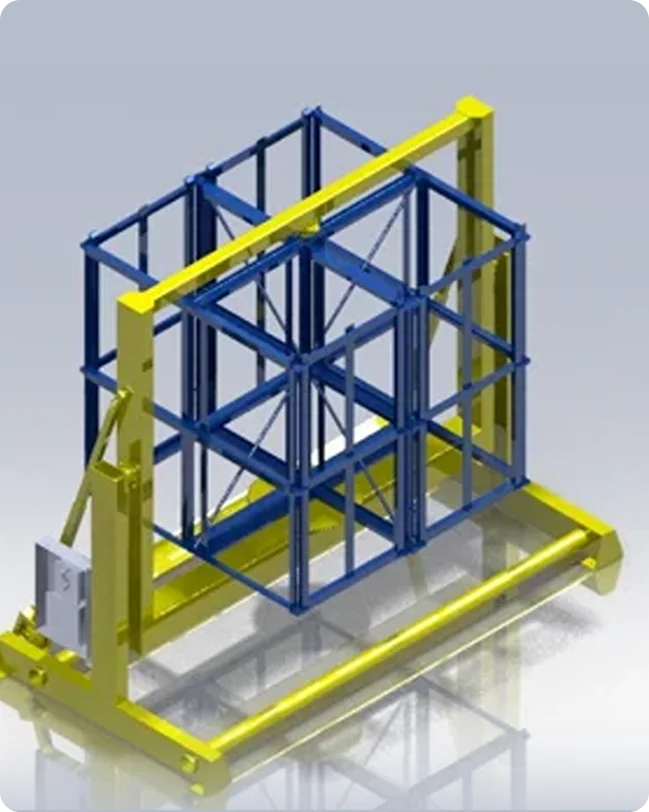
John developed the Very Large Machine—known as the Riddler or VLM—to automate the gradual turning and tilting of sparkling-wine bottles.
1980s–90s
A wider field of problems
Lakeport fabrication expanded into specialized retorts, public works equipment, packaging, food processing, fiberglass systems, and custom construction.
Today
NuTrend carries the method forward
John is applying the same whole-system thinking to biomass, filtration, wildfire resilience, circular manufacturing, and the difficult problems clients bring next.
The work continues
The same hands. A larger problem.
John’s experience was earned by building, repairing, operating, and learning in the field. Today, he is applying that same practical discipline to land, biomass, wildfire resilience, water, and the systems communities will need next.
Legacy is not only what was built before. It is the ability to recognize what is still possible—and prepare a pathway for it now.
Hospital steel, a 120-foot bell tower, specialized retorts, fire-water infrastructure, fabrication systems, and difficult installations.
In development
Wildfire, biomass & recovery
Connected approaches to accumulated biomass, wildfire risk, water, agriculture, manufacturing, and resilient communities.
From legacy to deployment
The next problem is larger—but the discipline is the same.
Today, NuTrend is carrying John’s field-tested discipline into connected environmental and manufacturing challenges. Biomass is not simply waste. Water is not merely a disposal problem. A damaged landscape is not without remaining value. The work begins by seeing the whole system and preparing each part to become useful again.
No smoke. No odor. No noise. No dredging.
BioMCycle™ / RipCycle™
The fiber, water, carbon, minerals, and manufacturing potential are already present. NuTrend is developing mobile, modular pathways that prepare those materials for useful participation again.
In development
Pre-pond filtration
Restore the pathway before solids become a pond problem: separate useful material earlier, protect water systems, and aim to eliminate recurring dredging.
In development
Wildfire resilience
Treat detection, verification, response, protection, recovery, water, land, and biomass as one living system—not a collection of disconnected emergencies.
In development
Resolute Institute
A Lakeport environment where people can see, test, build, train, and prove small-scale systems before preparing them for responsible deployment elsewhere.
In development
Demonstrate here.Benefit there.Deploy everywhere.
The first step
John K. Kalua Problem-Solving Review
Submit the problem, what has already been tried, and the photographs, videos, drawings, or records that help explain it. NuTrend will determine whether it is appropriate for an initial conversation with John.
A focused review of the available information
Questions aimed at the hidden failure point
A clear determination of the most responsible next step
A review is not a guarantee of outcome or a substitute for services requiring a licensed professional. Scope and fees are confirmed before paid work begins.
Submit a problem
What has everyone else given up on?
Tell us what is happening, who or what it affects, what the system was designed to do, and what has already been tried. Start with the truth. We will take it from there.